









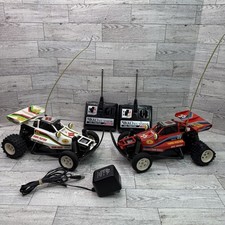


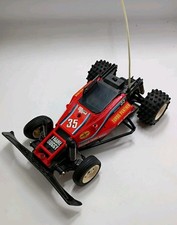

The Nikko Turbo Panther II was a 1/15 scale remote controlled buggy manufactured by Nikko (Japan), and released into various markets worldwide from 1989. Often misspelled as the Turbo Panther 2.

Global Success
In 1986 Nikko found global success with the original 1986 Nikko Turbo Panther, while also steadily producing so many other classics of the era such as the 1986 Nikko Dictator, the 1986 Big Brutus, manufacturing the hugely popular Golden Arrow for Radio Shack in 1987, and so many more I've yet to document.
It was a busy time for Nikko Japan and their American subsidiary Nikko America, Inc. which may go some way to explain why a successor to the Turbo Panther took three years, unlike their direct competitor Taiyo Japan who would continue releasing versions of their directly competitive Jet Hopper / Turbo Hopper year after year.
Features and Specifications
And yet when Nikko did finally release a new variant, it was more of a refinement of the original than a true successor. The car is essentially the same in specification, except for the on-paper size upgrade from 1/16 to 1/15.
With more exaggerated lines and a slightly larger rear wing and modernizing the wheels, the car is almost a cartoon version of the original which looks more mature yet dated when put side-by-side with this Panther II release.
- Larger 1/15 scale (compared to 1/16 of original)
- Larger Rear Wing with Aerodynamic vents
- Oversized skid plate at rear
- Exaggerated lines and curves, overall taller and bigger looking
- New wheel rims and spiked tires on front and back
- Same drive train, suspension, 9.6v battery power.


Comparison between Turbo Panther and Turbo Panther II
There are very few obvious differences between these cars, however I've not driven one then immediately driven another, just my own Turbo Panther original. The main difference is the slightly larger rear wing, redesigned bumper, and mega-sized wheelie bar.


Availability and Collectability
It's not too hard to find a Turbo Panther II, but they're certainly less common than the original, with very little information available online, I tend to think that either they didn't sell very well, or did'nt stay on the market very long before being replaced by another model.
Personally my own collection contains the first version of the Turbo Panther, and I'm not sure I'll grab the Panther II, though it would be a different story for someone who owned a Panther II when they were young.


