






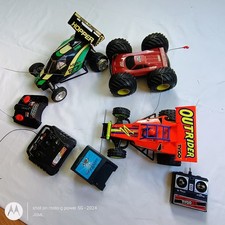


The Tyco Mini Aero Hopper is a 1/20 scale radio control buggy manufactured by Taiyo (Japan), and released in the US, UK, and other countries worldwide by Tyco Industries in 1988.
Models 2318-27 and 2318-49 released in 1988 are distinguished by the large front shock towers, together with the rear shocks providing the best suspension on a Mini Hopper there would ever be. Later Mini Aero Hopper models would replace these for an inferior suspension system.


Design
In the late 80s to early 90s, aerodynamics were the look of the future. From real life cars, to film and toys, the sweeping aero-efficient style was brought on by the leaps and bounds made in cheap everyday computing power which enabled widespread use of Computer Aided Design (CAD).

This new tool inspired designers to think outside the box, literally, enabling the use of more complex shapes and curves, such as Bézier curves, and as fuel costs rose, automakers employed CAD to create vehicles better optimized for airflow. This not only improved fuel efficiency but also harnessed the airflow to enhance traction where necessary, such as with rear wings to push the rear tires down for added traction.
Soon Aerodynamics were cool, and to be found everywhere - especially in toys. Which is why Taiyo, designer and manufacturer of the Jet Hopper / Turbo Hopper series decided to release an aerodynamic version of their most popular RC car. The full size 1/16 Aero Turbo Hopper, with this Mini Aero Hopper being its matching smaller variant, designed with younger kids and a sharper price in mind.
Features and Performance
Assuming you're using the right type of battery (which I cover below), performance on any Mini Hopper is still decent, especially if you're driving around indoors. Acceleration is good, and it's only top speed where you really notice the low voltage, and so indoor areas, and small outdoor courses are best.

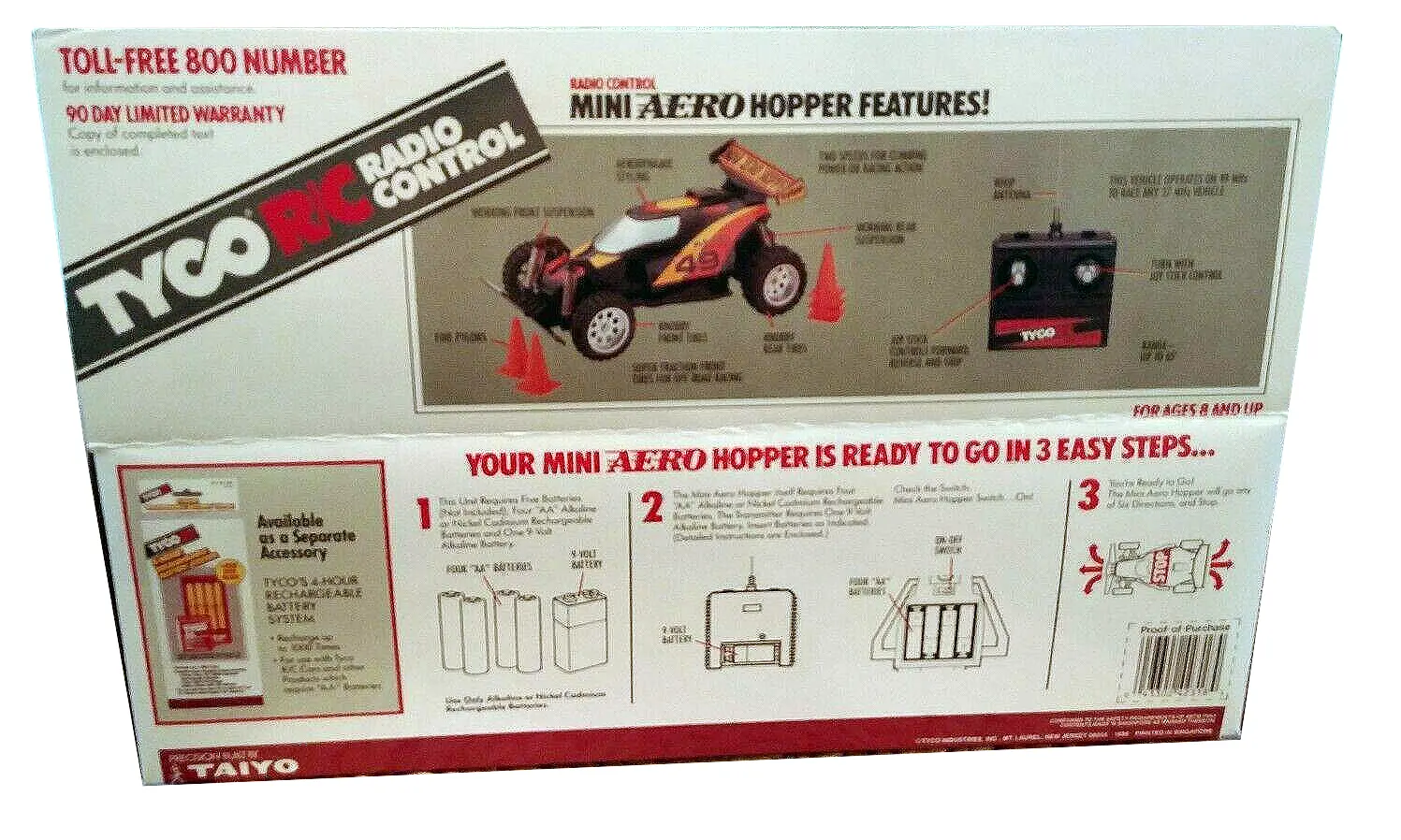
Equipped with 4 x shock absorbers including those large front shock towers and rubber tires, the Mini Aero Hopper is better than most toy store radio controlled cars sold in 2020. And their exceptional quality means they've lasted several decades largely without deterioration.
Taiyo versions were Made in Japan, and Tyco / Metro / Dickie versions were of equal quality, Made in Singapore under Taiyo Japan supervision.
With no known weak points (no common bumper breaks, body cracks, or anything) these tend to last.
Choice of Battery Makes a Big Difference!
Much like its Mini Hopper cousin, the Aero Turbo Hopper runs on 4 x AA batteries, however the power varied depending on the type of batteries used. The best batteries to use, both in 1988 and today are Alkaline delivering 1.5V each, for a total of 6.0 volts output. Nice! Of course, chewing through those can get expensive and is terrible for the environment, so you may prefer the rechargeable route. In 1988 those would be NiCd, and today they'd be NiMh, however both provide a mere 1.2V each, for a total of 5 volts. Ouch! A noticeable performance difference.
Those looking to get the most out of their Mini Aero Hopper I'd recommend 1.5V Lithium Rechargeable batteries. I have no preference on brand yet as I'm still trying, however my advice would be to avoid the ones that plug into USB, get some that insert into a (preferably included) charger, and don't just buy the cheapest you find, get something that looks half decent.

The Most Popular R/C Toy Ever?
The Mini Hopper was one of the most successful and widely produced radio control cars in history, with many different variants. Check our our Guide to the Mini Hopper for more!
US versions
International versions
- 1986 Taiyo Mini Hopper
- 1987 Taiyo Mini Hopper 2
- 1987 Taiyo Mini Hopper 2 (Rare)
- 1987 Taiyo Aero Mini Hopper
- 1988 Taiyo Mini Hopper 3
- 1988 Taiyo Aero Mini Hopper 3
Availability and Collectability
Mini Aero Hoppers are generally available in varying conditions on eBay, though boxed and New-In-Box is exceedingly rare (but can occasionally be found for later Mini Hopper varieties).
While I personally prefer the original Mini Hopper body, as most people would I suspect, those who owned a Mini Aero Hopper, or Aero Turbo Hopper as a child would no doubt be nostalgic towards this version. And the more I look at that black, orange, and red aerodynamic shell... the more I have to say it grows on me.
What about you? Did you own an Aero, and would you buy one now for the nostalgia?


