









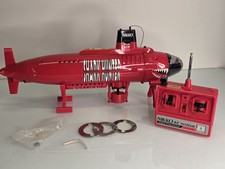
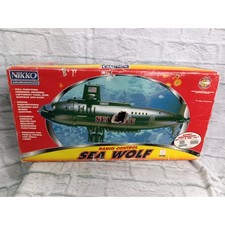


Also known as the Nikko Atlantis / Nikko Shark Hunter / Nikko Sea Wolf / Nikko Sea Star
The Nikko Submarine is a large radio controlled toy submarine produced by Nikko Toys (Japan), and released in the United States by Nikko R/C Systems, and across the globe by other regional distributors from 1983.

The same core design was also sold as other models with different names, colors, and decals. I suspect some of these may have been country/region specific, but so far it's hard to tell, and many appear to have been sold in the United States and most western countries. If you're aware of any significant feature differences between then, let me know!
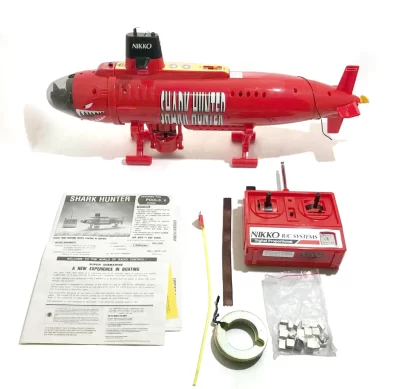
Shown below are the Nikko Super Submarine, Nikko Atlantis, Nikko Sea Star, Nikko Shark Hunter, and Nikko Sea Wolf.


There was also this silver or gunmetal version of the Nikko Sea Wolf. I've also seen army green versions, full yellow versions, and there's no doubt others. Of all R/C manufacturers in the 1980s, Nikko seems to have been the most prolific at varying and rebranding existing designs, which makes my job at documenting them all quite challenging!

Is it really a submarine? Yes, but not as you think.
Before we get into the details of this model, let's be clear about what this is and how it works.
When we think of Submarines, most of us will think of military submarines; a US Navy Sea Wolf class nuclear missile sub. A Russian Typhoon class. The Hunt for Red October. These all take on water to sink, and pump compressed air into those same tanks to rise.
Yet that's not how many hobby and toy submarines work. A far simpler design is better for when serious depths are not required - they simply use a 'submerge propeller' that pushes the submarine downwards, reducing or stopping the speed of that propeller to slowly rise.
The downside of this design is that to stay underwater it requires constant power, though it's a simple and reliable system that works well, even for more sophisticated hobby drone submarines.

Features and Performance
At over 20 inches long, it's quite an impressive model, with several owners commenting that it works and moves underwater very well, with only one (significant) drawback that we'll cover shortly.
- Steers left and right, dives down and surfaces
- 3 Channel Digital Proportional Radio Control
- Max. 2.5mph underwater
- 6 Radio Frequencies available enabling multiple subs to operate in close proximity
- Automatically surfaces when losing radio signal
- Able to be calibrated for optimal buoyancy with multiple weight systems
The overall design is quite clever, and has several mechanisms onboard to make it work.
At a glance
Batteries slide into the front of the submarine, after removing the front quarter (1). Along the bottom is the submerge propeller, a large unusual looking attachment which contains added circular plate weights that together work to pull the submarine deeper into the water (2). There is an internal servo that varies the angle of the rear propeller drive shaft to control steering (3). To adjust buoyancy more exactly there is an array of smaller weights that can be added and removed across twelve small holes with a screwed down cover, as you can see below (4). There is a system to keep the antenna packed away when stored (5). And finally at the rear you can see the propeller drive (6).

Weights
There are two types of weights included.
First the circular weights which are stacked around the submerge propeller housing.
Secondly there are small metal cubes which can be inserted along the bottom of the submarine in a screwed down compartment, as shown in a photo earlier in the article.
Together these systems are designed to achieve the required buoyancy suitable for whatever water and conditions faced.

Motors and Control
Diving and Resurfacing is controlled via the 'Submerge' button on the controller, and utilizes the main submerge motor and propeller combination together with circular weights as shown above.
Steering is achieved with a servo that tilts the rear drive propeller left and right as needed.
This photo was taken from an excellent thread on RC Groups where someone is trying to repair and upgrade their Nikko submarine. If you like this submarine, I'd recommend checking out that thread, it's super informative. Link: RCGroups

The underside of the submarine is where most of the work is done, with the submerge propeller together with main circular weights/ballast, and trim weights located in a 2 x 6 row along the bottom.

Batteries
Batteries are installed by removing the front of the submarine, removing a rubber watertight cover, and revealing the battery compartment and charge plug.
Packing a total of 6 x C Size batteries for the drive, plus 4 x AA batteries for the electronics, this is one heavy boy!

Removable Front Cover
The front of the Submarine is removeable, revealing a rubber cover that protects the battery bay and charge plug.
Attached by string, on the other end is the front cap of the sub which also houses a flotation ball, providing added buoyancy.

Each of the submarines came with the same accessories, manual, controller, stand, and weights.


Design Weakness
Those who have owned the Nikko Submarine often mention that it works very well in general, but can be hard to keep under the water (a tendancy to want to rise), and sadly getting down deep into a swimming pool isn't an option due to its key limitation - the radio antenna.
According to the instructions, you must ensure that the antenna tip stays above water in order to receive a signal. While some have speculated maybe it can't get fully wet, the actual reason is simply because radio waves don't penetrate water very well.
This is why so many of the more serious hobbyist and pro-consumer underwater drones rely on either a very long tether / wire connected directly back to the operator and video monitor, or connected to a floating antenna platform on the surface which transmits back to the operator.

Image from RC Sparks YouTube Channel (Click for Video)
Manual
Given this is a relatively complicated model, I've included the best copy of the instructions I could find, to assist anyone who has just got this model and is wondering how to get it working. This is for the Nikko Sea Star, but should apply to most or all of the variants.

Page 1

Page 2 and 3

Page 4
Availability and Collectability
While listings online will often quote these as being 'rare', there were so many sold and so many variants that you should'nt have trouble getting your hands on one in reasonable condition.
Whether they're collectable or not depends on your own personal tastes. Online there have been a few documented attempts at hobbyists trying to adapt and modernize the design to improve its range, and for that purpose it seems like a reasonable platform. However you feel about it, I think it's clearly one of the most unique and interesting models that Nikko ever made, and for that reason alone deserves to be documented, treasured, and remembered.
Did you own a Nikko Submarine? I'd love to hear about it, leave a comment below!


